
How to play
Village of Legends is a fantasy deckbuilding duel. Buy cards from the Market, build a stronger deck turn after turn, and use weapons, spells and monsters to bring your opponent's Hero down to 0 Life Points {hp}.
Online the game takes care of setting up the table, shuffling, counting Life {hp}, Intelligence {int}, XP and levels, and moving the cards: here you only find what you need to know to play. A game lasts about 5 minutes.
Victory and defeat
- You win when your opponent's Hero is reduced to 0 Life Points {hp}.
- A player who has no cards left at all (hand, deck and discard pile all empty, for example after removing too many cards) is eliminated.
- You can also surrender with the button at the top right.
Starting a game
- Choose your Hero (male or female) in the character page. The i on each Hero shows their stats and abilities.
- The game looks for an online opponent for a few seconds; if nobody answers, you play a training match against the computer.
- Every Hero starts with the same deck of 10 cards: 8 Coins {coin} and 2 Staffs.
- A random player starts. To balance the advantage, the first player draws only 3 cards on the first turn, the second player 5.
The Market
The Market board has 10 spaces:
- Spaces 1–5: the piles of Beer, Scroll, Spell and Potion cards (the top card is face up) and the Nuggets.
- Spaces 6–10: five face-up cards from the Main deck (weapons, defences, monsters, treasures…). When one is bought or removed, a new card from the Main deck takes its place.
Your turn
- Play the cards in your hand in any order. You don't have to play them all.
- When you play a card its primary effect (bottom left of the card) happens first, then its secondary effect (the text on the card).
- Buy and sell during your turn, whenever you like.
- Press End turn when you are done: the cards you played and those left in your hand go to your discard pile (defences and monsters in play stay where they are), and you draw 5 new cards. When your deck runs out, your discard pile is shuffled to make a new one.
- Each turn has a time limit (the clock at the top). If you have nothing left to do, the turn can end by itself (you can turn this off in the settings).
Buying
- Play treasure cards (Coin, Nuggets, Chest, Treasure Chest, Gem…) to get coins {coin}, then tap a card in the Market to buy it for the price at its bottom right. Unspent coins {coin} last until the end of the turn.
- Chests have a variable value: a die roll (plus any modifier on the card) × 10 coins {coin}.
- Bought cards go to your discard pile: you will draw them in the next turns.
- A monster in front of your Hero blocks the Market: while it is there you can't buy, sell or use Market effects.
Selling
- Cards with the price on a golden background can be sold from your hand for half their price (a card that costs 30 gives you 15 coins {coin}). Cards with a non-golden price can't be sold.
- A sold card is removed from the game, and of course you can't use it in the same turn.
Defence cards
- Defence cards (shield symbol {shield}) are placed in front of your Hero and stay there until they break.
- You can have only one of each type: one Armour, one Shield, one Helmet, one Cape. Playing a second one of the same type replaces the old one. Defence spells are different: you can have several, but not two with the same name (no two Stone Walls, but Stone Wall and Mirror Image together are fine).
- An attack must get through your defences before it reaches your Life {hp}. A defence breaks when, in the same turn, it takes damage {dmg} at least equal to its value {shield}; the damage it takes is forgotten at the end of the turn.
- Some defences only work against certain attacks (for example the Lizard Armour only against spells); any Intelligence {int} bonus on a defence applies every turn it stays in play.
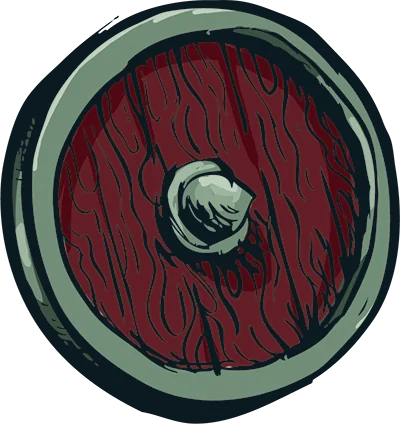
Weapons
- A weapon deals the die roll ± the bonus next to the die in damage {dmg}. You can play as many weapons as you like in a turn, except Heavy weapons.
- Monsters first: if there are monsters in front of your Hero, your weapons must hit them first. Only when they are all defeated can you hit your opponent again.
- Against an opponent with several defences, you choose the order in which they take the damage {dmg}. Damage left over after the last defence is lost (it doesn't reach the Life Points {hp}), and so is damage left over after the last monster in front of you.
- Armour bonus (for example "Shield 1" {shield} of some Heroes): every attack that reaches that Hero or monster deals X less damage {dmg}.
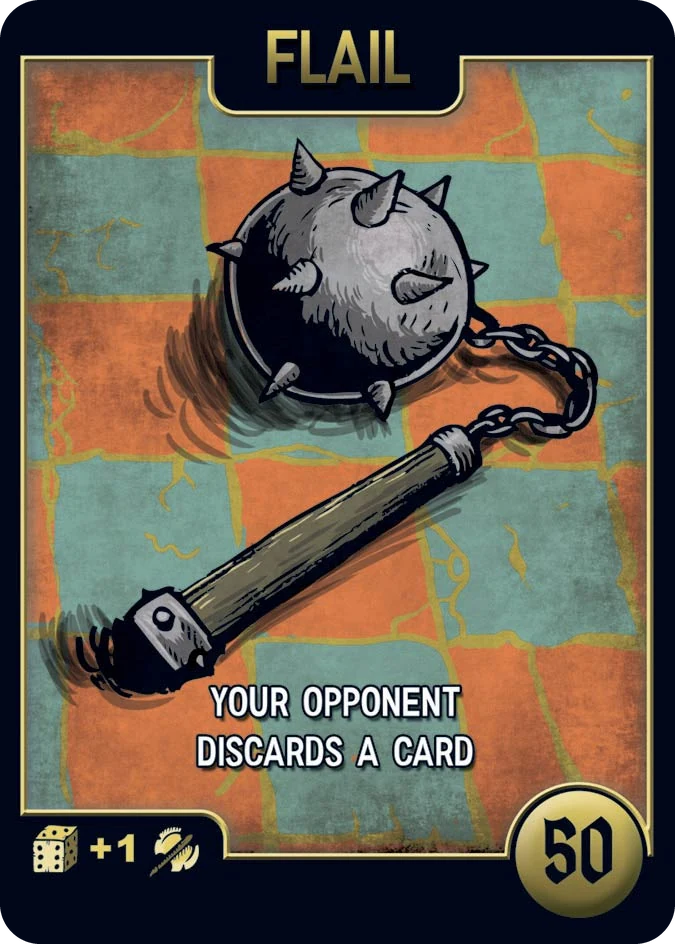
Heavy weapons
- Marked with the anvil. A Heavy weapon must be the only weapon you play that turn.
- Its leftover damage {dmg} is never lost: it goes on from the monsters in front of you, to your opponent's defences {shield}, to their armour bonus, to their Life Points {hp}.
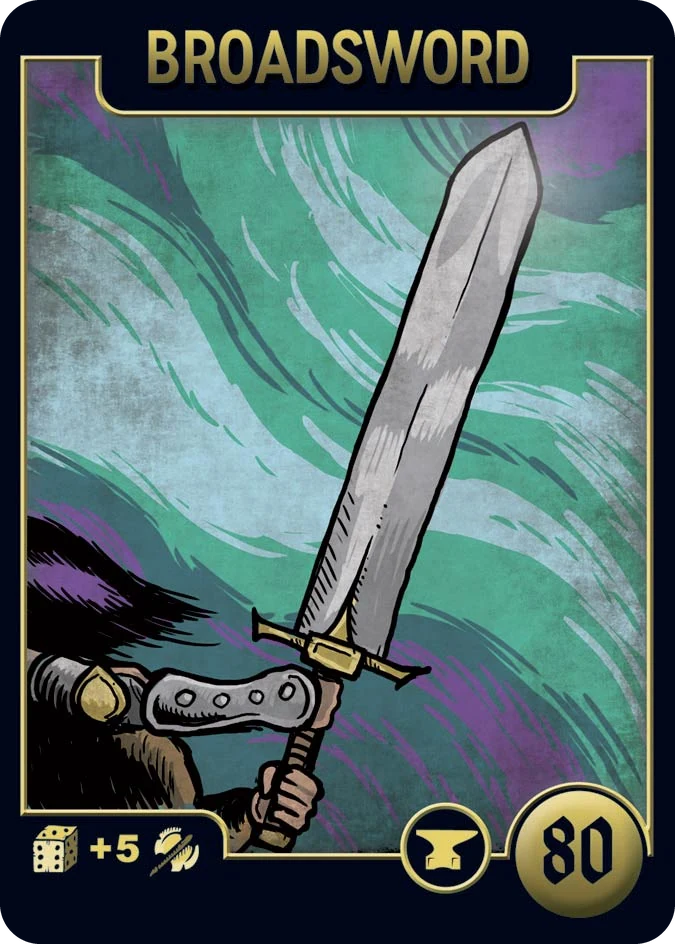
Intelligence, scrolls and spells
- Intelligence (INT {int}) is spent to cast spells and to use magic abilities. Your Hero gets back their full INT {int} at the start of each turn; some cards raise or lower it for the current turn only (too much Beer can even take it below zero).
- Scrolls (pile 2) can be bought by anyone, but only Heroes with at least 2 INT {int} can read them.
- Spells (pile 3) cost the INT {int} shown on the card.
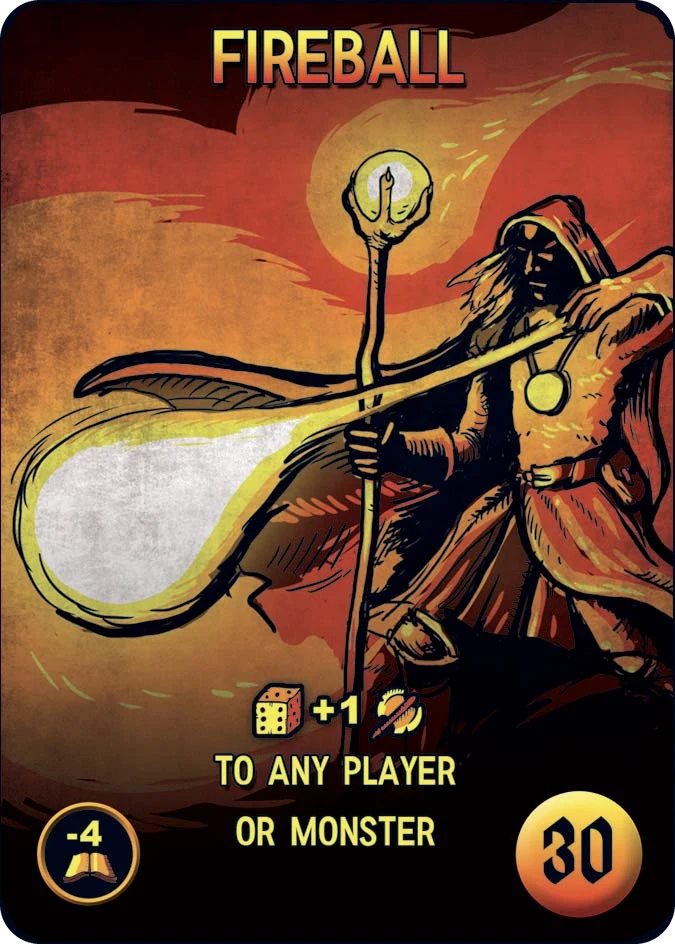
Attack spells
- Spell damage {dmg} works like a Heavy weapon: you choose the target (your opponent, or a monster in front of you) and the leftover damage carries on, from the monsters, to the defences {shield}, to the Life Points {hp}.
- Spells that hit several targets at once (for example Earthquake) don't carry their damage over.
Healing and defence spells
- Healing spells heal your own Hero by the die roll ± the bonus in Life Points {hp}, unless the card says otherwise.
- A spell with the shield symbol {shield} is a Defence spell: it stays in front of you and follows the defence rules.
Elements
Every spell belongs to an element: Fire, Earth, Water, Air or Mind.
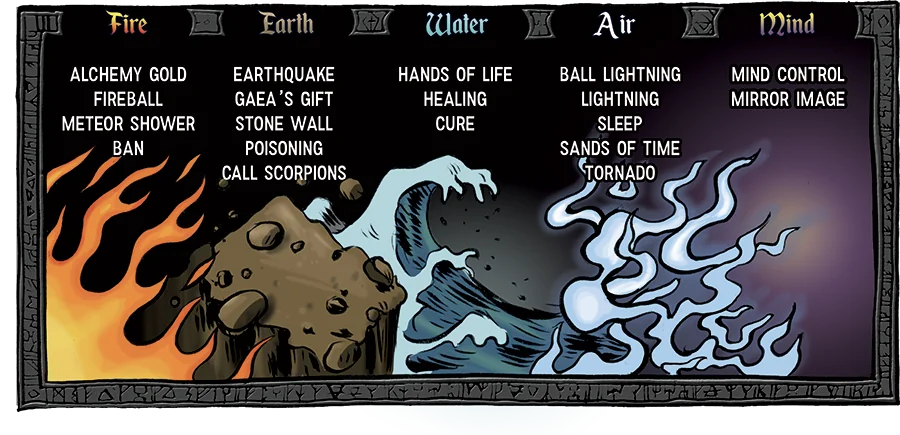
- Resistance: reduces the damage {dmg} of an attack of that element by the value shown.
- Immunity: an attack of that element deals 0 damage {dmg} to that monster or Hero, and the attack stops there.
| Spell | Element | INT | Effect |
|---|
Magical staffs
Magical staffs (like the Staff of Fire and the Thunderstaff) can be played as normal staffs (1d6 − 2 damage {dmg}). If you have enough INT {int} you can choose instead to spend it for a magic attack: it is a spell in every respect, with the staff's element.
Monsters
Buying and playing monsters
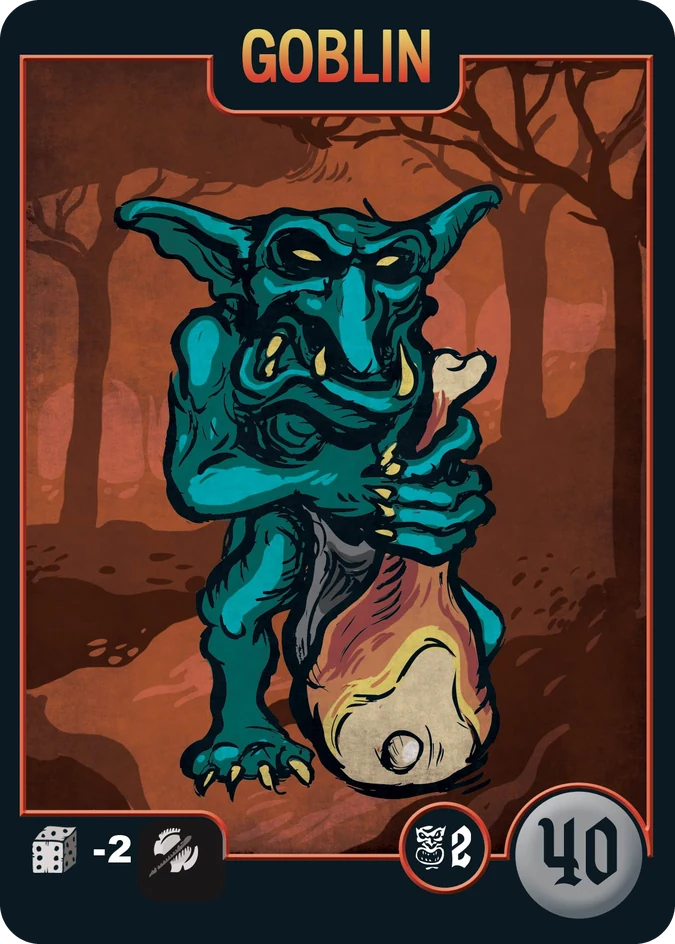
- Monster cards have a red frame. Like any card, a bought monster goes to your discard pile; when you draw it, play it in front of a player: in front of your opponent to attack them, or in front of yourself to fight it for XP (a Defensive monster in front of you protects you like a defence card).
- A monster in front of a Hero blocks the Market for that player and attacks them at the start of each of their turns, like a non-Heavy weapon (die roll ± its bonus in damage {dmg}). If you own it, you choose the order in which it hits your opponent's defences {shield}.
Fighting monsters
- Attack the monsters in front of you with weapons or attack spells. With several monsters you choose the order; leftover damage {dmg} goes on to the next one.
- A monster is defeated at 0 Life Points {hp}; wounds stay from one turn to the next.
- A defeated monster goes back to its owner's discard pile, and whoever defeated it gains XP equal to its Market price.
- If you play on a monster a card that makes "your opponent" do something (for example discard a card), it is still your opponent who does it.
Secondary effects
The text on a card always applies after its primary effect, and is mandatory whenever it is possible. Market effects are ignored while you can't use the Market.
- Draw a card
- From your deck; if it is empty, your discard pile is shuffled first. With no cards anywhere, nothing happens.
- Remove a card
- The card leaves the game instead of going to the discard pile (from your hand, or from the Market). Removing weak cards makes your deck stronger. A Hammer played as your last card has nothing to remove: play it last if you want to keep your cards.
- Discard a card
- The owner chooses which card, unless the card says "at random". It goes to their discard pile.
- Sheath
- Stays in front of your Hero. Once per turn, if it is empty, you can put a weapon from your hand on it, to play it in a later turn; when you play that weapon, the Sheath is discarded.
Experience and levels
- Defeating monsters gives XP (the monster's price). Every Hero has two more levels: reaching the XP shown for Level 2 and Level 3 unlocks their new abilities straight away.
- Tap your portrait (or the opponent's) during the game to see their XP, level and abilities.
Hero abilities
- +1 card
- Draw one more card at the end of each turn.
- X HP {hp} each turn
- Heal X Life Points {hp} at the start of each of your turns, after poison {poison} and the monsters' attacks.
- +X {shield} (armour bonus)
- Every attack that hits you deals X less damage {dmg}, after your defence cards.
- +X with a weapon type
- +X damage {dmg} with the weapons (or spells) of that type: see the weapon classes below.
- +X against monsters
- +X damage {dmg} when you attack monsters.
- Berserk
- Drinking enough Beer in one turn activates it for a die roll of turns (the current one included): +bonus damage {dmg} to every attack, but no Market. More Beer during Berserk doesn't extend it.
- Devotion
- All your monsters, played or summoned, deal +1 damage {dmg} each attack and count as Undead.
- Lifelink
- Before playing a non-Ranged weapon, press Lifelink: for every point of damage {dmg} it deals you can spend 1 INT {int} to heal 1 Life Point {hp}.
- Sabotage
- Once per turn, remove one card from the Market (you need access to the Market).
- Sneaking
- The monsters in front of you never block you: you can use the Market, and with your weapons you choose whether to hit the monsters or your opponent.
- Summon
- Spend INT {int} to summon creatures (mini cards) in front of your opponent. Whoever defeats them gains the XP on their card, then they disappear.
- Swordmaster
- Play as many weapons as you like in a turn, Heavy ones included.
- Taming +X
- +X to your roll when you try to tame a monster.
- Vision
- Once per turn, look at the next face-down card of the Spell pile, and put it at the bottom if you like.
Monster abilities
- Healing X
- Heals X Life Points {hp} each turn.
- Shield X {shield} (armour bonus)
- Every attack against it deals X less damage {dmg}.
- Charge
- At the end of the turn it charges the player with the most Life Points {hp} and attacks them, with +2 damage {dmg} on its first attack against a new player.
- Defensive
- It works like a defence card {shield} for the player it is in front of: it doesn't block the Market and it doesn't attack that player; attacks against that player hit it first. Defeating it gives XP.
- Fleeting
- When it is revealed in the Market it goes straight in front of the current player. It doesn't block the Market and at the end of every turn it moves in front of the other player. Defeated, it gives its XP and is removed from the game.
- Hopping
- At the end of the turn it moves in front of the other player.
- Immune to (type)
- Attacks of that type deal 0 damage {dmg} to it, and stop there.
- Overwhelm
- Huge creatures like dragons. When revealed it bursts onto Market space 10 and nobody can use the Market (buy or sell) until it is defeated. At the start of every turn it attacks the current player with all its cards, from left to right. At the end of every turn after the one in which it appeared, a new card of the creature enters the Market and the others slide left, swallowing the Market cards. You can attack it with weapons and spells (choose it as the target). When it is defeated, every player who wounded it gains the XP of its last card, and the swallowed cards are shared out one at a time, starting from the player who landed the last blow.
- Pickpocketing X
- Before attacking, it steals X random cards from the hand of the player in front of it and keeps them under itself. When it is defeated, the stolen cards go back to their owner's discard pile.
- Poison X {poison}
- If its attack deals at least 1 damage {dmg}, the Hero gets X poison tokens and loses 1 Life Point {hp} per token at the start of each turn, until cured.
- Proliferate X
- At the start of the turn, every X identical monsters together make a new copy.
- Sneak Attack
- Kobolds can't be bought: when one is revealed it attacks the player who revealed it, stays in front of them and moves to the other player at the end of each turn. Revealed during the first turns, it is removed from the game.
- Spectral
- It doesn't block the Market.
- Summon
- Before attacking it summons other creatures next to itself. They protect it (they are hit first) and disappear when it dies.
- Taming X
- To buy it you must first roll at least X (plus your Taming bonus); if you fail, it attacks you and stays in the Market.
Weapon classes
Some Heroes have bonuses (or limits) with certain weapon types.
| Class | Weapons |
|---|
Heroes
Starting Life Points {hp}, Intelligence {int} and abilities of every Hero you can play, with what they unlock at Level 2 and Level 3.